Posts

Showing posts with the label Geology

FORMATION OF MINERAL DEPOSITS

FORMATION OF MINERAL DEPOSITS The term mineral deposit has been explained in the opening page of this chapter. A mineral deposit is simply a deposit of minerals, * " I not necessarily commercially workable; the viability will vary with the price which fluctuates with time. Thus a mineral deposit, considered unprofitable at one time, may be economically extractable from a mine with increase in its market price. Magma isthe originalsource of most of the minerals. The magma which is chemically very reactive due to pressure, temperature and compostion of various minerals dissolves adjacent rocks through which it travels, giving rise to new minerals. The constituent minerals, mostly rock-forming silicates and oxides are deposited at various stages as the magma cools down during its passage. Minerals having nearly similar fusion points segregate and concentrate together resuling in magmatic segregation. Important deposits of metallic oxides such as magnetite and limentite, and sulphide...

strata-bound deposits

strata-bound deposits Strata-bound deposit types, minerals. Strata-bound deposits are mineral deposits that are confined to specific layers or strata of rock. There are several types of strata-bound deposits, including: Sedimentary exhalative (SedEx) deposits: These form from hot fluids that exsolve from volcanic or hydrothermal systems and deposit minerals in layers of sedimentary rock. Examples include sedimentary copper and lead-zinc deposits. Skarn deposits: These form from the alteration of limestone or dolostone by hot fluids, resulting in the precipitation of iron, lead, zinc, and other metals in the altered rock. Examples include the iron-copper skarns of the American Cordillera and the lead-zinc-silver skarns of the Mediterranean region. Volcanogenic massive sulfide (VMS) deposits: These form from the precipitation of sulfide minerals in submarine volcanic environments. Examples include the massive sulfide deposits of the Iberian Pyrite Belt and the Noranda deposits in Cana...

horizantal andvertical water well

A horizontal water well is a type of well that is drilled horizontally, rather than vertically. This type of well can access more water-bearing layers of the earth, and can also be used to avoid certain geological features, such as hard rock formations. A vertical water well, on the other hand, is a traditional well that is drilled straight down into the ground. This type of well is typically used to access water-bearing layers of the earth that are relatively close to the surface.

Stratiform Deposits.

Stratiform Deposits. Stratiform Deposits Mining Stratiform Deposits. types, examples, mining methods.  Stratiform deposits are mineral deposits that occur in layers or strata within the Earth's crust. These deposits can be formed through a variety of processes, including precipitation from mineral-rich fluids, precipitation from hydrothermal fluids, and sedimentation. There are several types of stratiform deposits, including: Sedimentary rock-hosted deposits, which form within sedimentary rock and can include coal, phosphate, and iron deposits. Volcanogenic massive sulfide deposits, which form in volcanic environments and can include copper, zinc, and lead deposits. Stratabound copper-lead-zinc deposits, which form in sedimentary rock and can include copper, lead, and zinc deposits. Examples of stratiform deposits include: The copper deposits in the Copperbelt of Zambia and the DRC The lead-zinc deposits of the Mississippi Valley type (MVT) The iron formations of the Lake Superi...

ore genises

introduction to deposit formation and transformation The formation of most of the earth’s mineral resources requires the presence of a fluid phase to extract the ore elements from their hosts by dissolution, to promote transport (mechanical and/or chemical) and ultimately to deposit them in suitable locales. Therefore, the knowledge and understanding of the fluid phase are critical to the development of any model of ore genesis. These fluids, which may vary widely in terms of composition, temperature, physical state, and flow characteristics, represent a state of matter in which the molecules are able to flow past one another without any limit or without any fracture or dislocation. Their state as gas, vapour, or liquid exhibits a progressively closer association of molecules and is characterised by different mechanical and thermodynamic properties. Understanding the genesis of ores through their characterization and obtaining the precise information of magmatic, hydrothermal, tecto...

Metamorphic Roks

Image
METAMORPHIC ROCKS Metamorphic rocks are altered forms of pre-existing rocks which might have been igneous or sedimentary. The alternation may be due to either heat or pressure or by both acting together. Un er t e effect of pressure and temperature certain of the original miners are no longer stable and give place to new minerals. Quartz, e spar, and hornblende are stable under both igneous and metamorphic conditions. In addition to new minerals, new textures arise during the process of alteration or metamorphism. Rocks not altered beyond recognition include quartzite (from sandstone) and slate (from clay). Rocks altered beyond recognition include rocks known as gneisses and schists. The original rock-forming material and the names of original rocks and metamorphic rocks produced by it are given below. Mineral Original rock Metamorphic rock Sand Sandstone Quartzite Clay Shale Slate, mica-schist Calcium ...

Sedimentary rocks

Image
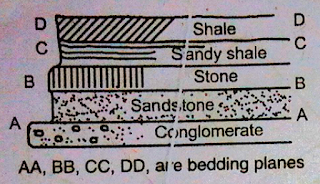
Sedimentary Rocks Sedimentary Rocks Sedimentary rocks include all rocks formed by deposition in beds or layers (strata) of the material derived from older rocks and also cover rocks formed by chemical or organic agencies. The materials may be carried by water, wind or glacier, e.g., in the case of sandstone, shale, etc. The majority of these sedimentary rocks are formed by deposition on riverbeds, or seabed and into basins or depressions on the earth's surface. The consolidation of loose sediments into hard also by deposition of cementing materials into spaces between particles of the sediments. The chief cementing materials or some mineral finely spread throughout the rock. The colour of the rock often changes on account of alteration of the original constituents due to atmospheric agencies, chiefly water. The sedimentary rocks were formed practically in the horizontal position but due to earth movements associated with earthquakes or other causes, they were tilted from the horizo...

Rocks

Image
types of rocks Rocks are divided as follows into three great groups based on the origin and mode of formation.  Igneous Rocks: Those that have consolidated at or relatively near the earth's surface from molten material called magma originating from within the earth.  Sedimentary Rocks: Those produced chiefly by the breaking up of pre-existing rocks and deposition of the broken material in the form of layers.  Metamorphic Rocks: Those produced from pre-existing rocks by the action of high temperatures and pressures. The rock cycle Igneous Rocks Igneous rocks are formed by the cooling of molten material called magma, at or relatively near the earth's surface. Magma is a Naturally formed mixture of molten rocks and minerals deep down the earth. The constituents of magma are mostly complex silicates and oxides of iron, aluminium, magnesium, calcium, sodium and potassium. Silica is always present in 35 to 75%. Most of the constituents of magma are nonvolatile with fusion temp...

The Common Rock Forming Minerals

Image
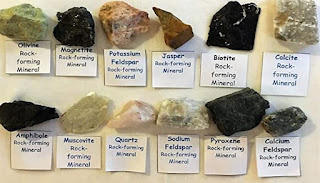
The most Common rock forming minerasl are listed below. 1- Silicates The felspars These are complex silicates of aluminium with potash, soda or lime and are most abundant in igneous rocks. Potash felspar, also known as orthoclase, is the most common type. It is white, grey or pink in colour with a glassy lustre. When weathered it leaves a hydrated silicate of aluminium known as kaolin or china clay. the soda and lime felspars are known as plagioclase. they also decompose and disintegrate in a similar way. [lagioclase felspars occur in most igneous rocks, especially the darker varieties rich in lime. the specific gravity of felspars is between 2.6 - 2.7 and its hardness on the scale of Mohs is 6. Mica this occurs as a white variety known as muscovite (a silicate of aluminium and potassium) and as a black variety known as black mica or biotite (a silicate of aluminium, iron and magnesium). the mica can be easily scratched by fingernail and has a well-developed cleavage. it is a common co...

Minerals and minerals properties

Image
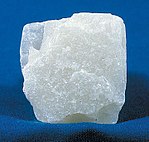
Minerals What is a mineral? Defining a mineral. A mineral is a naturally occurring inorganic solid, with a definite chemical composition, and an ordered atomic arrangement.  minerals possess definite physical properties by virtue of which they can be distinguished from one another. the most important physical properties are as follows: Colour: Some minerals possess a characteristic colour, e.g. galena, magnetite, olivine, etc' but in some others, the colour is variable e.g. quartz. Specific gravity: Most rock_forming minerals have a specific gravity between 2 and 4.  Lustre:  the lustre may be metallic (line galena or iron pyrites), pearly (like talc), or silky. Taste and smell:  Rock salt, alum, and other minerals can be recognized by their taste. Streak:  When drawn over paper or an unglazed porcelain plate, a few minerals leave a coloured mark known as the streak; for instance, graphite gives a black streak; hematite leaves a cherry red streak. Crystalline: A...

Mining Geology

Image
Mining Geology Introduction What is mining? Mining is the process of excavating minerals of economic value from the earth’s crus for benefit of mankind. Here we can assume that the earth’s crust, the outer surface of the earth, including the oceans, lakes and rivers, extends to depths of 30 to 50 km or so. For mining operations, one should have a working knowledge of geology. The word geology means the science of the earth and deals with the natural origin of the rocks that constitute the earth. A person interested in the extraction of minerals from the earth is, however, concerned with the thin surface of rocks that make up the earth crust to a depth of a maximum of 5 km so that geology enables him to locate, and to decide, the sites most economics form mining or quarrying. In geology, the terms minerals and rock have precise but different meanings. A mineral is a homogeneous and naturally occurring substance having definite physical properties and a composition that may be expressed...

Common Minerals

Image
Common Minerals About 107 elements are detected in laboratories, of which but only eight are found in abundance in the composition of the outer surface of the earth. These elements make up 98% of the Earth's visible crust. These are given (in order of frequency).  Oxygen              - 47% Calcium                3.5% Talc                     - 28% Sodium                 2.5% Aluminum              - 8% Pvtasym                    2.5% Iron                          - 5% magnesium           2.0% Total                98.5% Combinations of, these e...

Geochemically abundant and scarce metals

Image
Geochemically abundant and scarce metals Industrial and technological Metals applications can be divide into two categories based on their frequency of existence in the Earth's crust. Abundant geochemical metals, which are five elements (aluminium, iron, magnesium, manganese, and titanium), make up more than 0.1 percent of the earth's crust, while geochemical scarce metals, which include other metals as well (Including copper, lead, zinc, gold and silver), account for less than 0.1%. Almost in every rock, by accurate chemical analysis, at least small amounts of all metals can be detected. However, there are important differences in how abundant and rare metals occur in ordinary rocks. Geochemically abundant metals are present as basic constituents in minerals. Basalt, for example, is a common igneous rock composed mainly of the olivine and pyroxene (iron-magnesium silicate) minerals, feldspar (sodium-calcium-aluminium silicate), and ilmenite (iron titanium oxide). Accurate chem...

نهشت کانی سپرده های معدنی

Image
 نهشت کانی، سپرده معدنی (Mineral Deposits) سپرده معدنی ، تجمیع یک ماده معدنی با غلظت غیرمعمول بالا را گویند. حدود نیمی از عناصر کیمیایی شناخته شده دارای برخی ازخواص فلزی هستند. گرچه اصطلاح فلز فقط برای آن دسته ازعناصر شیمیایی اختصاص داده شده است که دارای دو یا چند مورد از خصوصیات فیزیکی مشخص فلزات (کدورت ، تورق، انعطاف پذیری، قابلیت ذوب) هستند وهمچنین رساناهای (conductors) خوبی برای گرما و برق هستند. تقریباً 40 فلز از طریق استخراج و ذوب مواد معدنی که در آنها موجود اند در دسترس قرار می گیرند.  انواع خاصی از مواد معدنی را می توان با آسودگی بیشتری نسبت به بقیه ذوب کرد؛ که معمولاً بنام مواد معدنی یاد میشوند. مواد معدنی معدنی تمایل دارند که در توده های سنگی محلی و کوچک متمرکز شوند که در نتیجه فرآیندهای خاص زمینی تشکیل می شوند و به این غلظت های محلی رسوبات معدنی گفته می شود. سپرده های معدنی همان چیزی هستند که جستجوگران به دنبال آن هستند. اصطلاحات کانه (ore mineral) و سپرده معدنی در اصل فقط برای کانی یا منرال ها و مواد معدنی که فلزات از آنها بازیابی می شد مورد استفاده قرار می گرفت، ا...

Popular posts from this blog

Different types of timber support

Indicated , inferred, measured resources

Timber support for different places in mine

50 common word roots, prefixes and suffixes

Options, Call & Put options, futures

Sandstone uranium deposits

Unconformity-Related Uranium Deposit

Roof support in underground coal mine