Posts

Showing posts with the label Radioactive Mineral Deposits

RADIOACTIVE MINERAL DEPOSITS

Radioactive mineral deposits. Types and examples Radioactive mineral deposits are areas where naturally-occurring radioactive elements such as uranium, thorium, and potassium are concentrated in the earth's crust. These minerals can be found in various types of deposits, including: Igneous deposits: These are formed from cooled magma or lava, and are typically found in granite and other types of intrusive rocks. Examples of igneous deposits include the Athabasca Basin in Canada, which is one of the world's largest producers of uranium, and the Oklo natural nuclear fission reactor in Gabon, which is the oldest known natural nuclear reactor. Sedimentary deposits: These are formed from the accumulation of sediment, and are typically found in sandstone and other types of sedimentary rocks. Examples of sedimentary deposits include the Witwatersrand Basin in South Africa, which is one of the world's largest producers of gold and also contains significant deposits of uranium, and ...

Uranium

Image
Uranium Uranium is a chemical element with symbol U and atomic number 92. It is a silvery-grey metal in the actinide series of the periodic table. A uranium atom has 92 protons and 92 electrons, of which 6 are valence electrons. Uranium is weakly radioactive because all isotopes of uranium are unstable, with half-lives varying between 159,200 years and 4.5 billion years. The most common isotopes in natural uranium are uranium-238 and uranium-235. Uranium has the highest atomic weight of the primordially occurring elements. Its density is about 70% higher than that of lead, and slightly lower than that of gold or tungsten. It occurs naturally in low concentrations of a few parts per million in soil, rock and water, and is commercially extracted from uranium bearing minerals such as uraninite. In nature, uranium is found as uranium-238 (99.2739–99.2752%), uranium-235 (0.7198–0.7202%), and a very small amount of uranium-234 (0.0050–0.0059%). Uranium decays slowly by emitting an a...

Introduction to radioactivity and radioactive material

Image
Introduction to Radioactivity & Radioactive material  Radioactivity is the Spontaneous emission of radiation, either directly from unstable atomic nuclei or as a consequence of a nuclear reaction. The radiation, including alpha particles, nucleons, electrons, and gamma rays, emitted by a radioactive substance.  A Closer Look: In the nuclei of stable atoms, such as those of lead, the force binding the protons and neutrons to each other individually is great enough to hold together each nucleus as a whole. In other atoms, especially heavy ones such as those of uranium, this energy is insufficient, and the nuclei are unstable. An unstable nucleus spontaneously emits particles and energy in a process known as radioactive decay. The term radioactivity refers to the particles emitted. When enough particles and energy have been emitted to create a new, stable nucleus (often the nucleus of an entirely different element), radioactivity ceases. Uranium 238, is a very unstabl...

Sandstone uranium deposits

Image
 Sandstone uranium deposits Uranium deposits hosted in Sandstone, occur in medium to coarse-grained sandstones deposited in a continental fluvial or marginal marine sedimentary environment. Impermeable shale/mudstone units are interbedded in the sedimentary sequence and often occur immediately above and below the mineralized sandstone. Uranium precipitated under reducing conditions caused by a variety of reducing agents within the sandstone including: carbonaceous material (detrital plant debris, amorphous humate, marine algae), sulphides (pyrite, H2S), hydrocarbons (petroleum), and interbedded basic volcanics with abundant ferro-magnesian minerals (eg chlorite). There are five main sub-types of sandstone deposits, often mixed: Basal channel deposits – wide channels filled with permeable sediments. Examples are Dalur and Khiagda (Russia), and Beverley and Honeymoon (South Australia). Tabular deposits – irregular, elongate lenticular bodies parallel to the depositional tre...

Unconformity-Related Uranium Deposit

Image
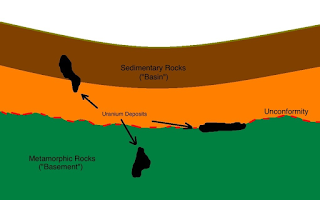
Unconformity-Related Uranium Deposits definition: Unconformity [ŭn′kən-fôr′mĭ-tē] A surface between successive strata representing a missing interval in the geologic record of time, produced either by an interruption in deposition or by the erosion of depositionally continuous strata followed by renewed deposition. An unconformity is a type of discontinuity.  or: An unconformity is time gap in the rock record between two rock units where the lower unit may be deformed, brecciated or altered and the overlying units are less deformed. Uranium deposits can occur in the underlying or overlying units. In the underlying units, there may be a weathering zone, fault zone or some other feature that increases the rocks porosity and permeability. In the overlying units, it may be the sandstones or some other features that allows the concentration of uranium.  Uranium unconformity deposits are generally associated with structures in sedimentary rocks that reflect the erosio...

Popular posts from this blog

Different types of timber support

Indicated , inferred, measured resources

Timber support for different places in mine

50 common word roots, prefixes and suffixes

Options, Call & Put options, futures

Sandstone uranium deposits

Unconformity-Related Uranium Deposit

Roof support in underground coal mine