Posts

Showing posts with the label Underground mining

Coal pillar load calculation by pressure arch theory

The pressure arch theory is used to calculate the load that a coal pillar can withstand before it collapses. The formula for calculating the load is: P = K * (σh)^2 / (2 * (1 - sin²θ)) Where: P = Load on the pillar (in pounds) K = Constant (usually around 0.6) σ = Stress on the pillar (in pounds per square foot) h = Height of the pillar (in feet) θ = Angle of internal friction of the coal (in degrees) An example of how to use this formula to calculate the load on a coal pillar is as follows: A coal pillar has a height of 200 feet and an angle of internal friction of 30 degrees. The stress on the pillar is 500 pounds per square foot. Using the formula above, we can calculate the load on the pillar as follows: P = K * (σh)^2 / (2 * (1 - sin²θ)) P = 0.6 * (500 * 200)^2 / (2 * (1 - sin²30)) P = 0.6 * (100,000 * 100,000) / (2 * (1 - (0.5)²)) P = 0.6 * 10,000,000,000 / 0.75 P = 8,000,000,000 pounds So the load on the pillar is 8,000,000,000 pounds. Please note that these are rough calculati...

Flame safety lamp.

flame safety lamp  types relighting procedure limitation test to be done specification for use components Open sidebar Flame Safety Lamp Types A flame safety lamp is a portable lighting device that is designed to be used in potentially explosive atmospheres. There are several types of flame safety lamps, including: Davy lamps, which are the oldest type of flame safety lamp and use a mesh screen to protect the flame Carbide lamps, which use a chemical reaction between water and calcium carbide to generate a flame Electric lamps, which are powered by batteries or other electrical sources and use a small flame to ignite a gas or other fuel The relighting procedure for a flame safety lamp will depend on the specific type of lamp. For example, a Davy lamp may need to be re-lit using a match or lighter, while a carbide lamp may need to be refilled with water and calcium carbide. The limitations of flame safety lamps include the need for frequent maintenance and refilling, as well...

Coal Dust Explosion

Image
 Coal Dust Explosion  Definition  An explosion is the Sudden combustion process of great intensity characterised by mechanical destructive effects through pressure and heat. For coal dust to ignite, combustible dust may be present in form of thick clouds.  Thick cloud of coal dust + O2 + ignition source (flame) ==> initiates combustion of coal Stages of Coal dust combustion stage 1  Ignition often starts as a puff, i.e. sudden combustion of part or whole of the air-borne dust with high temperature, but no marked effects. stage 2 The transition from Puff to Explosion; during this stage Pressure in burning layers increases as the heat of combustion, is transferred to surrounding unburnt layers due to radiation. stage 3 full fledge explosion; when the pressure value exceeds a certain value, a full-fledged explosion in which combustion occurs at a very rapid rate as a result heat is transferred totally rather than lost to its surrounding.  once the pressure ...

Iron and steel support in underground mining

Image
Iron and steel support in underground mining  Iron and steel are used in mines in the form of rigid and yielding props, beams and girders, reinforcement in concrete, corrugated sheets and roof/floor bolts. Steel props used in the miners are: a)      Rigid props b)        Yielding props An ordinary Horizontal section steel girder of suitable length with the web cutaway and flanges turned over at one or both ends is the common type of rigid prop. If the prop buckles in use it can be straightened by hydraulic pressure situated at the pit bottom. Another timber core through major length extending 25 to 40 mm beyond the steel pipe at either end. The timber core yields to some extent to the roof weight. Yielding Props:  1. Friction Props MAMC Friction Props: The friction props type FP3 manufactured by M.A.M.C. consists of two seamless steel tubes of which the inner member is made captive to the outer member by means of a spring locki...

Timber support for different places in mine

Image
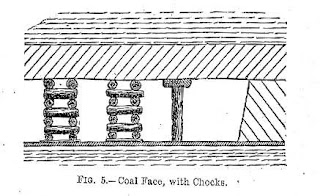
Timber support in coal mine Side Support:  Wooden laggings are placed tight between vertical props and pillar where the sides are weak and need support. Sometimes the timber set of prop and bar has to resist pressure from sides which tend to crush into the roadways. Notching is useful in such cases. The props should be set at an angle of 14° to 20° off the vertical and the feet well sunk into the floor. An alternative method of resisting side pressure is to sink the props well into the floor and to reinforce the timber-set by an additional bar or stretcher (dotted bar in fig), which may be nailed to the props. As this reduces effective height of roadway, its use may not be advisable in roadways of less than 2 m height, used by basket loaders. Reinforced Timber set or chockmate Notched Prop Support of a Roadway:  Where the roof of a roadway is bad over some distance bars resting in holes of coal pillars and tightened against the roof by wooden laggings may be...

Different types of timber support

Image
Different types of timber supports  Timber props  Timber placed normally between the roof and floor of roadways, etc. in coal mines is called timber prop. Timber prop in metal mines is sometimes called stull. A timber prop when erected in a mine to support the roof should yield slightly under the roof weight. The timber prop is strongest when the load acts parallel to its length; a prop as such is almost unyielding but a certain yield is obtained by; a) tapering it at the foot or top, or b) and providing a lid at the top as a compressible cushion between the roof and the end of the prop. In flat seams the prop is erected vertical, and in inclined seams, axis of the prop should be normal to the dip of the seam. The prop then offers the maximum resistance to the roof. A prop which is so set that its axis is between the vertical and the normal to the seam is known as and underset prop. Erection of underset props is not common as it is not possible for the timberman to...

Roof support in underground coal mine

Image
Roof support in underground coal mines Roof support in underground mines is used: To prevent major collapses of the mine roof; To protect miners from small rock falls that can occur from the immediate roof skin; To control deformations so that mine openings remain serviceable for both access and escape, as well as for ventilation of the mine workings Ensure continuity of ore production to avoid shortage in profit.  Finally, keeping expensive machines in the underground mines safe (e.g. machines used in long wall mining. When do we need to support mines? If there are weak or unconsolidated parts of rocks are present in the roof and walls of mines.  If there some geologic structures (e.g. shear zone) that weaken rocks.  If there are voids and spaces in the rocks. If there are some clay beds that can shrink and expand due to its swelling property, and hence sliding of rocks in presence of water can be expected. If there are underground water that helps i...

Popular posts from this blog

Different types of timber support

Indicated , inferred, measured resources

Timber support for different places in mine

50 common word roots, prefixes and suffixes

Options, Call & Put options, futures

Sandstone uranium deposits

Unconformity-Related Uranium Deposit

Roof support in underground coal mine